Junior Achievement Portugal

May 03 2022

Opinion article
slider-1
slider-2
slider-3
slider-4

Our experience at the Junior Achievement competition was truly enriching. We got to put what we learned in the classroom into action by identifying a problem and creating a product to solve it. Even though we did not pass to the national final, we enjoyed meeting other students, and experts, and have gotten a lot of feedback from them. We are excited to continue to improve Impartial and to move forward with our idea. Thank you, Mr. Carvalho and Mrs. Pinto for all of your help! - Carolina Vivas

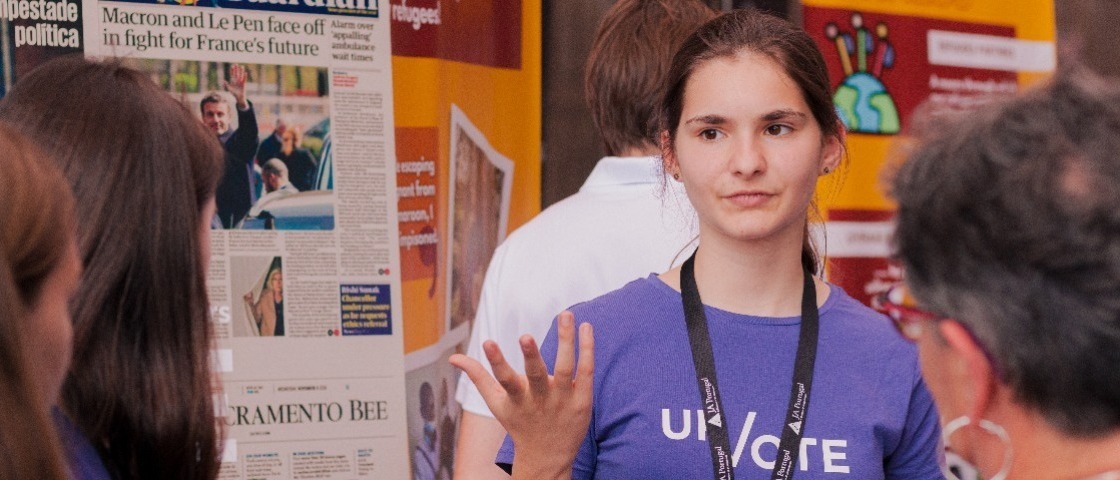
CLIP took part in another edition of Unlimited Fair, the regional stage of "The Enterprise" competition, promoted by Junior Achievement Portugal. Team Impartial represented the school with the "URVote" app. This project from our F9 & F10 students aims to solve the growing abstention levels and the generalised disinterest that youngsters show towards politics.

Being a part of impartial was definitely a very rewarding experience. From having the opportunity to work alongside amazing people that I wouldn’t usually work with, to being able to expand my horizons in regard to the ups and downs of entrepreneurship, I am grateful to everyone involved in making this project as dynamic and worthwhile as it was. And even though our journey was cut short, it is certainly something that I will remember for a very long time. - Marta Costa

Throughout the Unlimited Fair, that took place in Mercado Ferreira Borges, team Impartial had to pitch their idea to a panel of judges and showcase their app on a stand. Experiences like this develop our students' skills, taking education far beyond the classroom. Congratulations to Impartial for their performance, and for wanting to be part of a more political literate future.

This experience was truly unique. I must thank Mrs. Pinto, Mr. Carvalho, Rafaela, Valentina and Carolina for welcoming me and Marta to Impartial. It was really fun to have all the meetings and the “Feira Ilimitada” was truly a thrilling occurrence. I absolutely loved it. Thank you! - Matilde Lopes

Junior Achievement Portugal

Last news

February 16 2026
OPOMUN 2026 - Debate Overview
  OPOMUN 2026 brought together a diverse group of young delegates united by a shared commitment to diplomacy, collaboration, and global problem‑solving. Over three days, students engaged in thoughtful debate on humanitarian crises, climate security, economic development, disarmament, public health, and international governance. This extended overview provides a comprehensive narrative suitable for publication on the school website, highlighting key themes and including select quotes from official resolutions.   The conference stood out for the depth, ambition, and global awareness demonstrated by its delegates. Despite the range of issues addressed, the conference revealed a shared vision: protecting civilians, strengthening global systems, promoting sustainability, and cooperating across borders. The students showcased diplomacy, leadership, and critical thinking — qualities that reflect the school’s values and the potential of a generation ready to shape the world.   HUMANITARIAN PRIORITIES Across all committees, a strong humanitarian focus shaped the debates. Delegates consistently highlighted the need to protect civilians and guarantee access to essential aid. As stated in a Security Council resolution, “Ensuring immediate, safe, timely, and unimpeded access for humanitarian personnel and aid deliveries…” In the Human Rights Council, the urgency of safeguarding vulnerable populations was echoed: “the establishment of UN‑coordinated humanitarian corridors… to ensure the safe delivery of humanitarian assistance”. These discussions underscored the delegates' recognition that humanitarian protection is central to international peace and security.   STRENGTHENING GLOBAL GOVERNANCE Delegates also demonstrated a sophisticated understanding of the importance of transparency and accountability in global institutions. Anti‑corruption measures and institutional reform featured prominently. One resolution called for “Deploying UN‑backed forensic financial investigators to trace stolen assets abroad” Efforts to support more effective multilateral systems were present in multiple committees, showing that students recognise the need for trustworthy, well‑governed institutions.   CLIMATE CHANGE, AGRICULTURE, AND SECURITY With climate change increasingly linked to global insecurity, delegates integrated environmental concerns across many topics. An ECOSOC proposal introduced a major initiative, the “Global Farmer Safeguard and Adaptation Policy”, aimed at supporting food security, protecting farmers from climate-induced risks, and promoting sustainable agricultural practices. The connection between climate and instability was also raised in discussions on displacement, resource scarcity, and long‑term resilience.   INTERNATIONAL HEALTH PREPAREDNESS The WHO committees addressed both antimicrobial resistance and emergency preparedness. Delegates stressed the fragility of global health systems and emphasised the need for investment in infrastructure and crisis‑response capabilities. One resolution stated “strengthen hospital infrastructure, emergency care units, and mobile medical facilities… during pandemics, natural disasters, and armed conflicts” This future‑minded perspective highlighted students’ awareness of global interdependence and the lessons learned from recent public‑health emergencies.   TECHNOLOGY, SECURITY, AND INTERNATIONAL LAW Emerging technologies were a key theme, especially in disarmament. DISEC delegates focused on regulating drones, calling for “the establishment of the Automated Aerial Systems Monitoring Centre… to track registered commercial drones”. Their proposals demonstrated an understanding of the challenges posed by modern technologies when misused by non‑state actors.   TRANSNATIONAL CRIME AND ARMS CONTROL Across UNODC committees, delegates addressed threats posed by organised crime and illicit weapons flows. One resolution proposed “the establishment of Joint Maritime Task Forces… to monitor and intercept vessels suspected of violating international arms embargoes”. By focusing on international cooperation, financial transparency, and improved border management, students showed maturity in tackling complex global security issues.